
The Report Has Arrived. Now What?
A penetration test has been completed. The report contains critical, high, medium and low-risk findings. Management has received the executive summary. IT has received the technical findings and remediation recommendations.
So what happens next?
This is where one of the biggest weaknesses in traditional cybersecurity assessment begins. Finding vulnerabilities is not the same as reducing risk. A VAPT report should therefore not represent the end of a cybersecurity engagement. It should establish the starting point for measurable security improvement.
1. A “High Risk” Rating Is a Starting Point — Not the Final Answer
A high-risk result can feel alarming, but the rating by itself does not tell leadership everything it needs to know. Risk becomes meaningful when the organization understands which weaknesses can be exploited, which systems are affected, which attack paths are possible and what the likely business impact would be.
Two organizations can have the same number of high-severity vulnerabilities and still face very different levels of real-world exposure. One may have strong segmentation, MFA, monitoring and tested backups. The other may have weak privileged access, poor visibility and a flat network architecture.
The objective should therefore be to move beyond a vulnerability count and establish a clear picture of exploitability, exposure, business impact and control effectiveness.
2. Vulnerability Scanning Is Not Penetration Testing
Automated vulnerability scanners are valuable. They identify outdated software, insecure configurations, exposed services and known weaknesses across large environments quickly and consistently.
But a scanner mainly answers: What might be vulnerable?
Penetration testing asks a different question: What can actually be exploited?
Manual validation can determine whether a weakness is a false positive, whether several weaknesses can be chained together, whether access can be escalated and whether a technical issue can become a meaningful business event.
For a deeper introduction, read What VAPT Means for Kenyan Enterprises, Financial Institutions and Growing Businesses.
3. From Individual Vulnerabilities to Real Attack Paths
Attackers rarely think in isolated findings. They look for combinations. An insecure workstation might provide an initial foothold. Weak credential controls may allow access to another system. Excessive privileges may provide administrative access. Poor segmentation may then allow lateral movement toward a critical application, database, backup environment or domain controller.
Initial Access
How could an attacker first enter the environment — exposed service, phishing, vulnerable application, weak VPN or compromised endpoint?
Privilege Escalation
Can a low-level account become an administrator or obtain access beyond its legitimate business role?
Lateral Movement
Can the attacker move between systems, users, branches or network segments after gaining the initial foothold?
Critical Asset Access
Can the attack path reach business-critical applications, core systems, sensitive information, identity infrastructure or backups?
Several moderate weaknesses can therefore combine into one serious attack path. Mature VAPT should show not only what is vulnerable, but how vulnerabilities connect to business exposure.
4. Prioritize Business Risk — Not Vulnerability Volume
A report containing 80 findings does not necessarily mean the organization should fix finding number one through number eighty in sequence.
Remediation should prioritize the weaknesses that create the greatest risk reduction when fixed. Quest considers exploitability, asset criticality, internet exposure, privileged access, attack-path dependency, data sensitivity, likelihood of disruption and the strength of compensating controls.
A technically severe vulnerability on an isolated, non-critical system may be less urgent than a medium-rated weakness that provides a direct path into a core business application.
5. Red Team Thinking: Prove What Can Actually Happen
The offensive-security perspective asks how an attacker could realistically compromise the environment within agreed rules of engagement. This can include controlled testing of authentication and authorization, privilege escalation, Active Directory attack paths, network segmentation, application logic, external exposure and lateral movement.
The objective is not disruption. It is to convert assumptions into evidence and identify the attack paths that matter most.
6. Blue Team Thinking: Close the Paths That Matter
Once attack paths have been validated, defensive improvement should target the controls that can break those paths.
- Identity & Access: MFA, RBAC, least privilege, privileged access controls and regular access reviews.
- Endpoint Security: hardening, EDR/XDR, patching and endpoint configuration control.
- Network Security: segmentation, firewall rule improvement, secure remote access and architecture hardening.
- Applications: secure authentication, authorization, API controls, patching and secure development practices.
- Data Resilience: tested backups, recovery validation, encryption and ransomware resilience.
- Monitoring: centralized logging, detection, MDR/SOC capability and effective alert escalation.
- Governance: ownership, policy, cyber risk registers, incident response and management oversight.
7. Remediation Without Retesting Is Still an Assumption
A ticket marked “closed” does not necessarily mean the vulnerability or attack path has been eliminated.
If the original assessment showed that an attacker could escalate privileges, bypass segmentation or exploit an application weakness, the organization should verify that the corrective action actually prevents the same attack from succeeding again.
Retesting provides that evidence. It distinguishes between a documented fix and an effective fix.
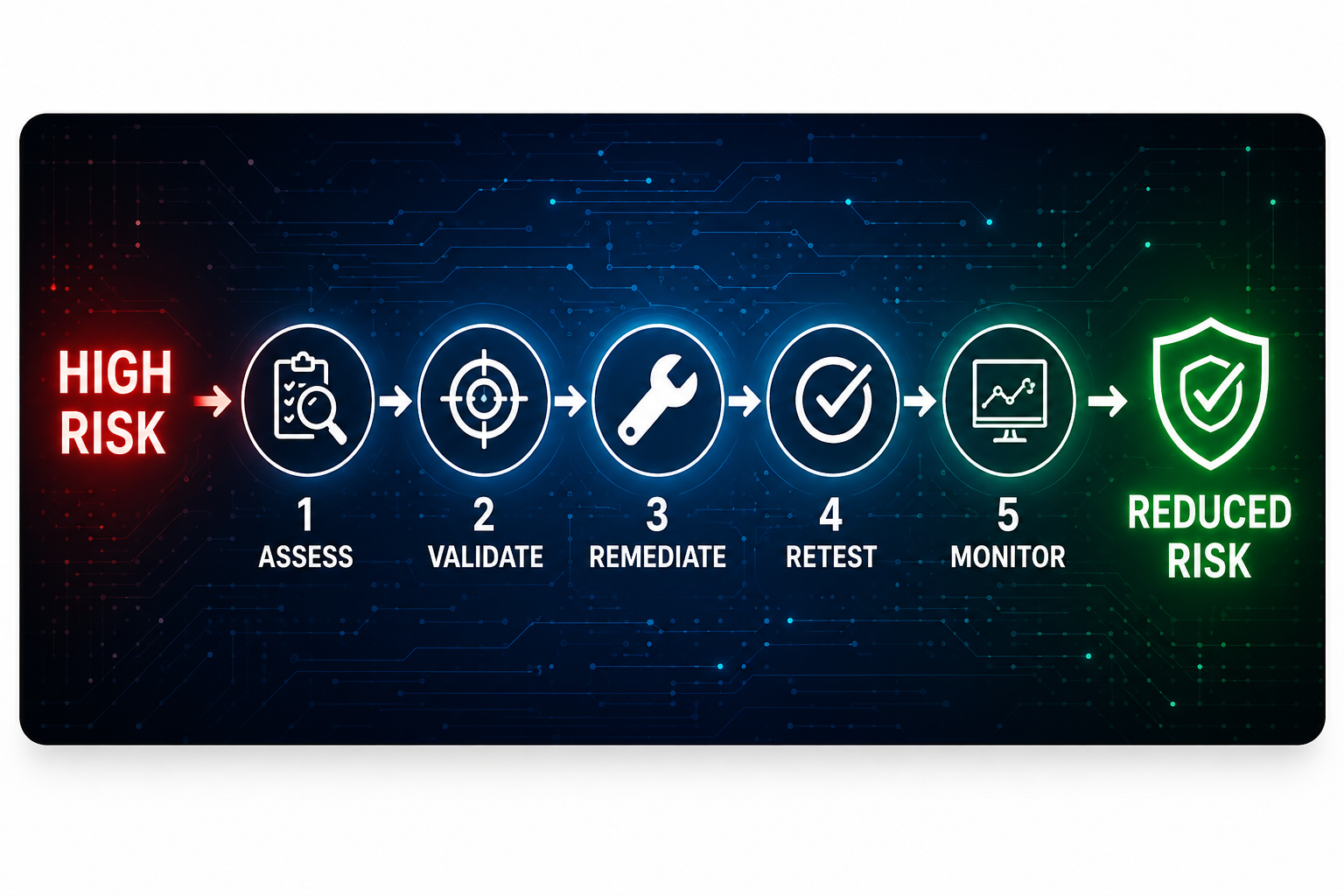
8. The Cyber Risk Reduction Lifecycle
The strongest approach is not a one-time test. It is a continuous improvement cycle:
1. Assess
Understand the environment, critical assets, controls, exposure and current security baseline.
2. Validate
Confirm which vulnerabilities and attack paths are genuinely exploitable and establish supporting evidence.
3. Remediate
Prioritize and strengthen the technology, processes, identity controls, architecture and governance that matter most.
4. Retest
Verify that corrective actions closed the identified weakness and prevented the original attack path.
5. Monitor
Maintain visibility over changing systems, users, threats and configurations so the environment does not silently drift back into risk.
6. Improve
Use new evidence, incidents, assessments and business changes to continuously strengthen the cyber posture.
9. Evidence Changes the Cybersecurity Conversation
Many security assessments still rely heavily on questionnaires and verbal confirmation. An organization may state that MFA is enabled, backups are tested, endpoint protection is deployed or privileged access is controlled.
The stronger question is: Can the organization prove it?
Evidence may include approved policies, system configurations, access matrices, screenshots, logs, backup reports, penetration-test evidence, monitoring records, incident exercises and other auditable proof that controls are implemented and operating.
This changes cybersecurity maturity from a statement of intent into something that can be validated and measured.
10. Why This Matters to Boards, Regulators and Insurers
Cybersecurity is no longer only an IT discussion. Boards, risk committees, regulators, auditors, insurers and business partners increasingly need confidence that cyber risk is understood and being actively managed.
For a board, the question is whether critical business services are resilient. For a regulator, it is whether required controls and governance are demonstrable. For an insurer or broker, it is whether declared controls are credible and whether the underlying exposure is being reduced.
VAPT alone does not make an organization insurable. But technically validated controls, evidence-based assessment, remediation, retesting and continuous monitoring can provide a much stronger basis for understanding and demonstrating cyber risk.
11. From VAPT to Cyber Risk Assurance
The next evolution of cybersecurity assessment is broader than finding vulnerabilities.
Cyber Risk Assurance brings together technical assessment, evidence validation, offensive testing, defensive remediation, governance, retesting and monitoring so that an organization can demonstrate not merely that controls exist, but that risk is being actively reduced.
This aligns with Quest Technologies Ltd's broader cybersecurity approach: Know Your Exposure. Fix What Matters. Build Continuous Protection.
It also builds on the principle discussed in Why Most Cybersecurity Investments Fail: owning security tools is not the same as proving that the environment is protected.
12. Five Questions Your Next VAPT Should Answer
- Which weaknesses can actually be exploited?
- What attack paths could lead to our most critical systems and data?
- Which remediation actions will reduce the most business risk first?
- How will we prove that remediation actually worked?
- How will we monitor the environment so the same exposure does not quietly return?
If the engagement cannot answer those questions, the organization may have received a vulnerability report — but not yet a complete risk-reduction roadmap.
The Bottom Line
A VAPT report that says “High Risk” should not create panic, and it should not become another document filed away after a management presentation.
It should trigger a disciplined sequence of validation, prioritization, remediation, retesting and monitoring.
The objective is not to reach a world with zero vulnerabilities. That is unrealistic. The objective is to understand what matters, reduce exploitable exposure, strengthen resilience and continuously demonstrate that the organization is becoming harder to compromise.