
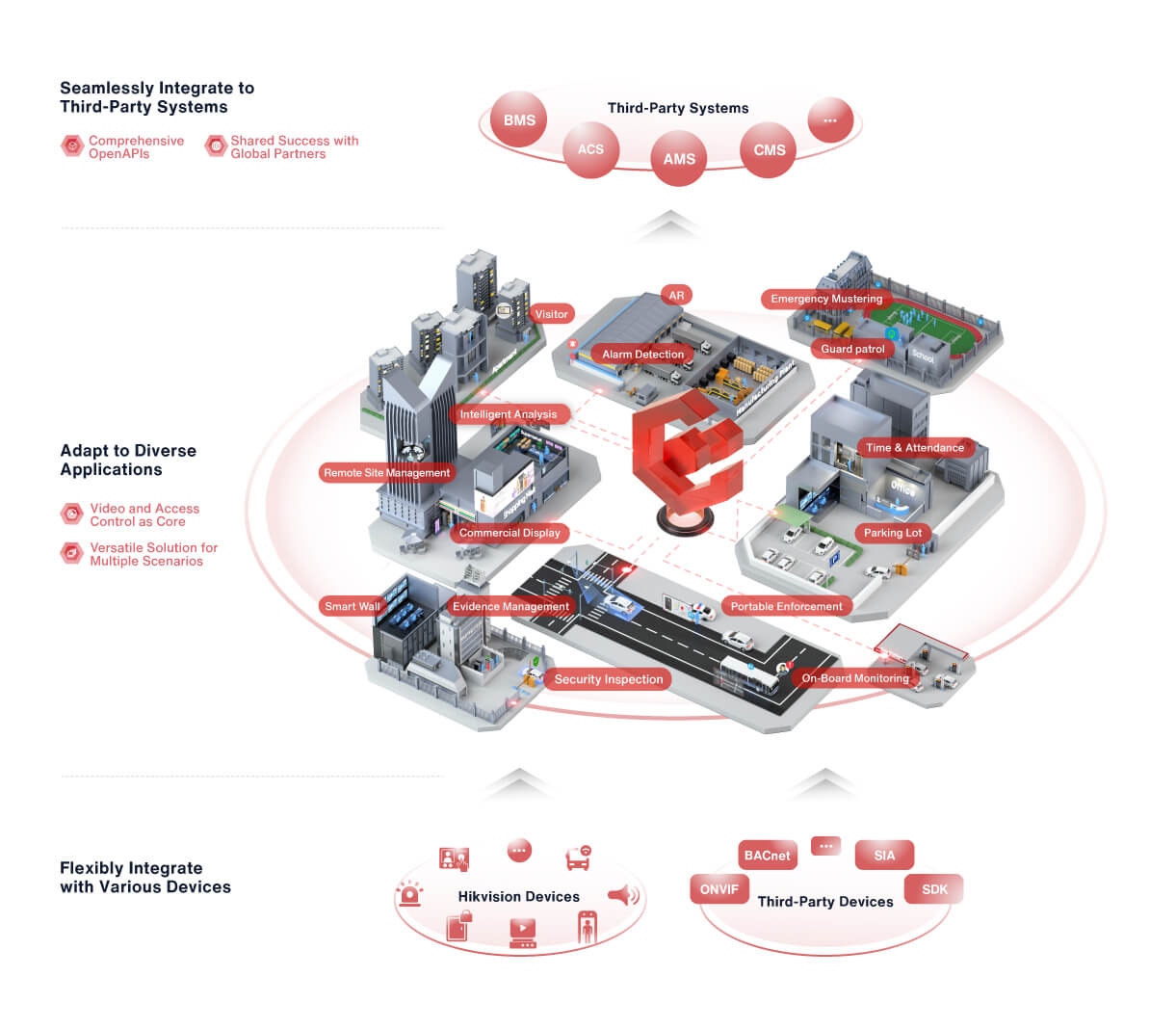
Security rarely fails because an organisation has no security technology. More often, the problem is that important controls operate as separate islands: CCTV sits with facilities, access control sits with security, the network sits with IT, endpoint protection sits with the security team, servers and storage sit with infrastructure, and power continuity may be managed somewhere else.
Each system may work correctly on its own. The weakness appears between them.
What fragmented security looks like
Fragmentation is easy to create. An organisation may add a new CCTV system after an incident, deploy access control during an office expansion, upgrade the firewall during a network project, purchase endpoint protection after a malware event, and add backup or UPS capacity when continuity becomes a concern.
Over time, the organisation can end up with multiple consoles, separate credentials, different suppliers, inconsistent asset records and no common view of what is happening across the environment.
The issue is not that these technologies are unnecessary. The issue is that security decisions, alerts, data and response actions may not be connected.
The security boundary is bigger than the firewall
Modern organisations operate through a combination of people, identities, endpoints, applications, networks, buildings, physical assets, data centres, cloud services, suppliers and power systems. A disruption in one layer can affect another.
Quest's current systems-integration model reflects this broader environment: secure networking, cybersecurity, physical security, data infrastructure, collaboration and control environments, and power continuity are treated as connected engineering disciplines rather than isolated product categories. See Quest's systems-integration approach.
Seven layers of an integrated security architecture
1. Physical security
Perimeter protection, CCTV, access control, visitor management, alarms, occupancy awareness and incident detection provide visibility and control over physical environments.
2. Network and connectivity
Secure LAN, WAN, wireless and fibre infrastructure connects users, sites and systems while segmentation and policy enforcement reduce unnecessary exposure.
3. Cybersecurity and identity
Identity controls, MFA, endpoint protection, vulnerability management, application security, firewalls and response processes protect digital access and reduce attack paths.
4. Servers, storage and data protection
Compute, storage, backup and recovery architecture protects the information and applications that operations depend on.
5. Power and continuity
UPS, batteries, solar and other continuity measures help critical technology remain available when the power environment becomes unstable.
6. Command, monitoring and response
Control rooms, security monitoring, centralised logs, alerting and response workflows turn separate signals into operational decisions.
7. Governance and accountability
Policies, roles, escalation paths, evidence, maintenance, testing and lifecycle ownership make the architecture sustainable after implementation.
Integration layer
Defined interfaces, APIs, event flows, common identity and clear operating procedures allow the layers above to exchange useful information without forcing every system into one platform.
Integration is where the real operational value appears
Consider a facility where an access-control event, CCTV camera, network device and incident-management workflow are completely independent. An operator may need to search several systems before understanding what happened.
In a more integrated design, the same event can be correlated across the relevant systems. Access events can provide context for video investigation. Network segmentation can isolate sensitive devices. Security monitoring can correlate suspicious activity. A control room can present the information needed for a response team to act.
This does not mean every device must be connected to every other device. Good integration is selective: connect the systems where shared information improves detection, verification, response, continuity or accountability.
Kenya's ICT environment increasingly requires architecture, not isolated deployment
The ICT Authority's published standards include Government Enterprise Architecture, interoperability, ICT networks, information security, data centres, cloud computing and systems and applications. Together, these standards illustrate why technology environments increasingly need to be designed as connected architectures rather than collections of unrelated deployments.
For public-sector environments in particular, architecture and interoperability are explicit concerns. For private-sector organisations, the same engineering principle is useful even where a specific government standard does not apply: systems should have clear ownership, security requirements, interfaces, lifecycle plans and measurable operational outcomes.
Review the ICT Authority's published ICT standards.
Where fragmented security creates practical problems
Blind spots
Important signals may exist in different systems without anyone correlating them quickly enough to identify a wider incident.
Unclear ownership
Facilities, IT, cybersecurity, operations and vendors may each own part of the environment without a clear end-to-end response path.
Duplicated investment
Organisations can pay for overlapping monitoring, storage, connectivity or management capabilities because systems were acquired independently.
Weak incident context
An alert without identity, asset, physical-location or business-process context can be harder to investigate and prioritise.
Vendor hand-off risk
When multiple vendors are responsible for adjacent systems, faults and security events can fall into the gaps between contracts and support boundaries.
Continuity gaps
A resilient application can still fail if the network, storage, physical site or power environment is not designed for the same continuity requirement.
What integrated security does not mean
Integration should not be confused with putting every security function into one dashboard or replacing every existing platform. Nor does it mean choosing one vendor for everything.
A sound architecture can combine technologies from different manufacturers where interoperability, security, supportability and lifecycle economics make sense. The engineering objective is to create a controlled environment with clear interfaces and accountability.
A practical path from fragmented to integrated security
- Map what exists. Identify sites, users, identities, networks, applications, physical systems, servers, data stores, power dependencies, monitoring tools and support contracts.
- Identify what matters most. Map critical business processes, assets and dependencies. Not every system requires the same protection or availability level.
- Find the gaps between systems. Look for disconnected alerts, duplicate data, weak interfaces, unclear ownership, unsupported equipment and manual workflows.
- Design the target architecture. Define segmentation, identity, integration points, data flows, monitoring, resilience, access, response and lifecycle responsibilities.
- Integrate priority workflows first. Start with high-value use cases such as access events, incident detection, critical network assets, privileged identities, backup and recovery, or control-room visibility.
- Validate the design. Test configurations, applications, network controls and response procedures. Security architecture should be challenged before it is trusted.
- Monitor and improve. Establish ownership, maintenance, reporting, alert tuning, periodic testing and a roadmap for the next integration priorities.
Integrated security starts with the business, not the equipment list
A technology-first approach asks, “Which cameras, switches, firewalls or servers should we buy?” An architecture-first approach asks different questions:
- What must remain available?
- What must be protected?
- Who needs access, and under what conditions?
- What physical and digital events could disrupt operations?
- Which systems need to exchange information?
- What should happen when a critical alert is raised?
- Who owns the response?
- How will the organisation prove that the controls continue to work?
These questions lead to a more durable security design because they connect technology decisions to operational outcomes.
Why this matters for enterprise and institutional environments
A corporate campus, hospital, SACCO, university, factory, logistics operation or government facility may have very different technology stacks, but the underlying challenge is similar: physical and digital operations are increasingly dependent on one another.
A network outage can disable security devices. A compromised identity can expose applications. A failed storage system can affect surveillance evidence. A power interruption can take critical infrastructure offline. A physical incident can become a cyber incident when connected devices and credentials are involved.
Integrated security therefore becomes a resilience discipline as much as a security discipline.
From products to one accountable engineering architecture
Quest Technologies' current positioning is built around systems integration: secure networking, cybersecurity, physical security, data infrastructure, collaboration and control environments, and power continuity. The objective is not simply to install individual technologies, but to engineer environments where those technologies support a common operational outcome.
That is especially important when an organisation has inherited systems from different projects, vendors or technology generations. Integration can provide a structured path forward without assuming that everything must be replaced at once.
Build the architecture around what matters
Moving from fragmented security to integrated security is a process of understanding dependencies, reducing blind spots and creating clear accountability. It starts with assessment and architecture, then moves through integration, validation, monitoring and continuous improvement.
Organisations do not need to integrate everything on day one. They need a defensible architecture and a prioritised roadmap that connects the systems that matter most to operational resilience.
Is your security environment fragmented?
Quest Technologies can help map your existing security and technology environment, identify integration gaps and develop a practical roadmap across networking, cybersecurity, physical security, data infrastructure, monitoring and continuity.
Systems Integration • Cybersecurity • Secure Networking • Physical Security
Kenya & East Africa
Related Quest capabilities
- Integrated Networking & Secure Connectivity — secure LAN, WAN, SD-WAN, wireless, fibre, segmentation and resilient network architecture.
- Cybersecurity & Digital Risk Protection — exposure assessment, remediation, secure infrastructure and continuous protection.
- Physical Security & Centralized Control — surveillance, access control, incident detection and operational oversight.
- Servers, Storage & Data Protection — compute, storage, backup, recovery and data resilience.
- Security Monitoring & SOC — continuous visibility, investigation and guided response.
- Hybrid Solar & Backup Power — continuity for critical technology environments.
- AV, Collaboration & Control Rooms — command, communication and decision-support environments.
Further reading
- Quest Technologies Ltd — Engineering-Led Systems Integration
- Quest — Enterprise Networking & Secure Connectivity Solutions
- Quest — Physical Security & Centralized Control
- Quest — Cybersecurity & Digital Risk Protection
- Quest — Security Monitoring & SOC Services
- ICT Authority Kenya — ICT Standards
Editorial note: This article is a Quest Technologies thought-leadership piece based on the company's published systems-integration and solution architecture, supplemented by the ICT Authority's published standards. It is intended as practical engineering guidance, not as a regulatory certification or claim that every organisation requires the same architecture.